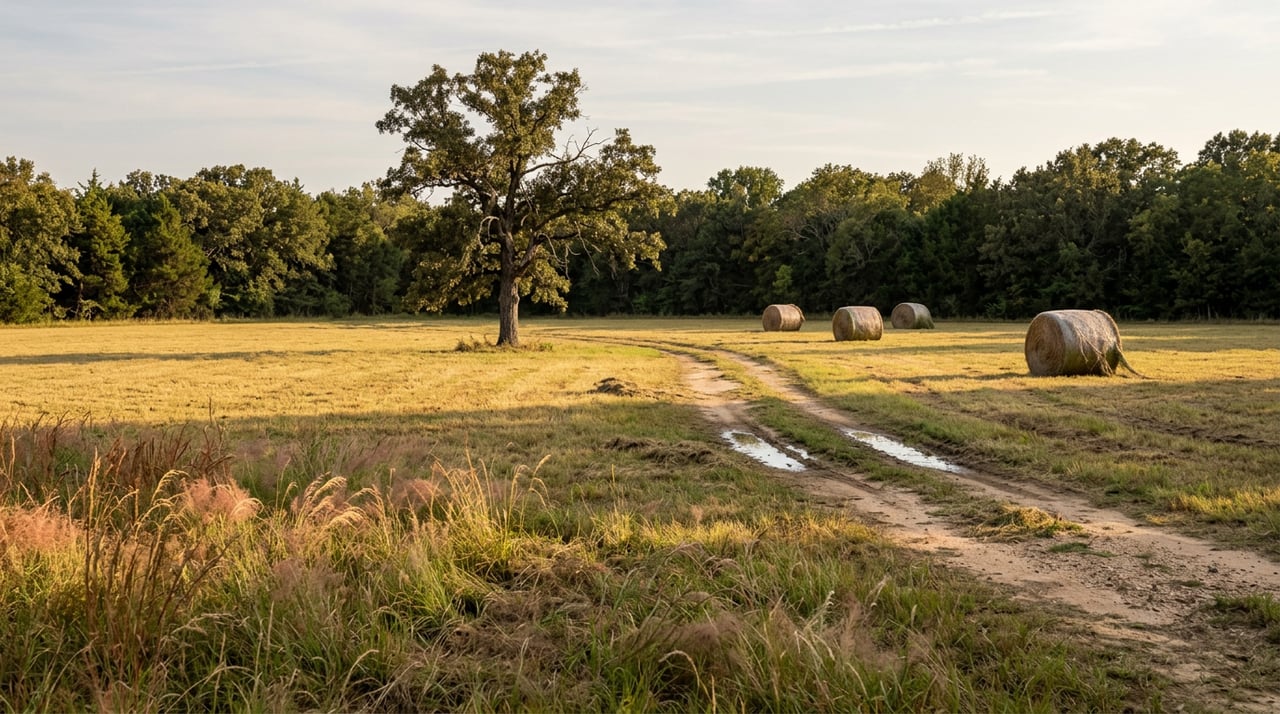
You are standing on a stretch of oak-and-pine acreage outside Flint, agent's flyer in hand, and one line jumps out before the price does: the annual tax bill is small. A few hundred dollars a year on twenty acres that would cost thousands anywhere else. It reads like a bonus. The figure reflects the land's current use and can change if that use changes.
That is the piece most out-of-area buyers miss when they start comparing acreage around Flint and Lake Palestine, and it is worth walking through before you fall for a tax line instead of a property.
An exemption that isn't one
Ballard Property Tax Protest explains that Texas does not actually have a property tax exemption for agricultural land. What it has is a special appraisal method, commonly called an ag exemption, that taxes qualifying land based on what it can produce rather than what it would sell for on the open market. A tract with a market value in the hundreds of thousands of dollars might carry a productivity value of only a few thousand, and the owner pays taxes on that lower number instead.
The gap between those two figures is where the appeal comes from. It is also exactly what makes the low number fragile. The valuation is tied to a specific use, tested every year, and it travels with the land only as long as that use continues.
What actually ends the low number
Buying ag-valued land does not, by itself, trigger anything. The clock only starts when the qualifying use stops. Build a home where cattle used to graze. Fence off a section for a yard. Stop running livestock and never replace them with another qualifying activity. Any of those can end the valuation, and when it ends, the county recalculates what you would have owed at full market value going back through the years the land carried the lower appraisal.
The Texas Comptroller says that lookback runs three years. That is actually the friendlier version of the rule. The Texas Legislature's analysis of H.B. 1743 shows that a prior version of the statute reached back five years at 7 percent interest before state lawmakers shortened it, so if you run across an older guide or an out-of-state advisor citing the longer timeline, it is describing a rule that no longer applies.
Smith County Appraisal District, the office that actually administers this for land in and around Flint, states it plainly in its own FAQ: the rollback tax is due for each of the previous three years the land received the lower appraisal, calculated as the difference between what was paid under agricultural value and what would have been paid at market value. That bill lands on whoever owns the land when the use changes, not necessarily on whoever benefited from the lower taxes for years beforehand. A buyer who never ran a single head of cattle can still owe the full amount if they are the one who ends the qualifying use.
The threshold most buyers never check
One detail buyers should check is the district's acreage threshold. Smith County Appraisal District publishes its own qualification standards for agricultural and timberland appraisal, and they are more specific, and more limiting, than the general statewide rules most guides describe. As of Smith CAD's currently linked 2022 standards, still the district's operative guidance in 2026, any tract under five total acres is not eligible for a 1-d-1 agricultural open-space appraisal at all, regardless of what is happening on it. That floor alone rules out a large share of the small platted lots that make up much of the Flint and Lake Palestine land market, many of which run well under an acre.
For tracts that clear the floor, the intensity requirements get specific fast:
| Activity | Smith CAD published threshold |
|---|---|
| Any use, any activity | Under 5 total acres does not qualify for 1-d-1 open-space appraisal |
| Grazing on native or wooded pasture | Under 20 acres, owner must show ability to provide supplemental feeding |
| Grazing on improved or hay pastureland | Under 10 acres, owner must show ability to provide supplemental feeding |
| Beekeeping | Qualifies on 5 to 20 acres, with six active hives required for the first five acres and one additional hive for each additional 2.5 acres |
That table is the difference between an assumption and a plan. A lot of buyers walking acreage near Flint assume that if it has grass and a fence, it is agricultural. Smith CAD's own guidelines say otherwise: the district calls out explicitly that livestock grazing is not the principal use of residential tracts, and that the standard exists to exclude land carrying only a token connection to agriculture. Wooded land does not qualify for timber appraisal just because trees are standing on it either. It requires a real management plan and a demonstrated intent to produce income from it.
Why the gap matters more in Flint than in the county at large
This is where the math gets locally specific rather than generic. Smith County's land market as a whole, per current listing data, runs at a median of roughly $20,000 to $22,000 an acre. Flint's own inventory this year tells a different story. Raw acreage tracts in the twenty to fifty acre range around Flint, including parcels near Noonday just outside town, have been asking anywhere from about $50,000 to nearly $100,000 an acre, several times the county's broader median.
That premium exists because buyers are paying for proximity to Lake Palestine and Tyler, not for the land's ability to produce hay or run cattle. But the rollback tax is calculated on the spread between market value and productivity value. The wider that spread, the larger the number waiting on the other side of a change in use. A tract priced at a lake-adjacent premium and still carrying an ag valuation is holding a bigger deferred bill than a similarly sized tract out in a less sought-after part of the county, even though the annual tax line on both listing sheets might look nearly identical today.
Put another way, the low tax number is doing the least work to describe the property precisely where the land is most desirable, which happens to be exactly where a Flint or Lake Palestine buyer is most likely to be looking.
What to actually check before you write an offer
A few questions, asked before closing rather than after, do most of the protective work:
- What specific activity is currently qualifying the land, and how long has it been documented, since the Texas Comptroller says qualifying land generally must have been devoted to agricultural or timber production for at least five of the past seven years.
- What is the county's current productivity value versus market value for this specific parcel, which tells you the real size of the gap and therefore the real size of any rollback exposure.
- If your plan includes a homesite, how many acres will actually be carved out of production, since the Texas Comptroller's Manual for the Appraisal of Agricultural Land says rollback applies only to the portion diverted to a non-agricultural use.
- Who bears the rollback liability if the use changes after closing, a point that belongs in the purchase contract rather than discovered later at the tax office.
- Does the parcel even clear Smith CAD's own acreage floor for the activity you have in mind, using the district's published thresholds rather than a general statewide rule of thumb.
None of this makes acreage near Flint a bad idea. Land in this part of East Texas remains a real long-term asset, and plenty of buyers hold ag or wildlife valuations for years without incident by simply keeping the qualifying activity going, whether that is a grazing lease, a documented wildlife management plan, or a working apiary. The point is narrower: know what you are buying into before the low number on the flyer becomes a bill with your name on it.
A few questions Flint buyers tend to ask
Does purchasing ag-valued land trigger the rollback tax by itself? No. The obligation attaches to a change in qualifying use, not to a change in ownership. You can buy ag-valued land without setting anything off, as long as the existing use continues.
How many acres do I actually need near Flint to qualify? There is no single statewide number. Smith CAD's own guidelines set a five-acre floor for any 1-d-1 qualification, with additional acreage thresholds depending on the specific activity, as shown above. Below that floor, no activity qualifies.
What if I only want to build a house on part of a larger tract? Texas law allows proportional carve-outs. Developing a portion of a larger parcel triggers rollback only on the converted acreage.
If you are weighing acreage near Flint, Lake Palestine, or anywhere else in this part of Smith County, and want a second set of eyes on what a specific tract's tax picture actually looks like before you make an offer, Jana Dillard works this exact market every day and can help you separate a genuine deal from a deferred bill. Book a Consultation to talk through the parcel you have in mind.
This article is general information, not legal, tax or financial advice. Consult a qualified professional about your situation.